
Labrador is the internal name researchers found for the search index OpenAI runs for ChatGPT. On free ChatGPT accounts, most web results came from it in summer 2026, not from Google or Bing.
So ranking on Bing no longer covers ChatGPT. This guide explains what Labrador is, what it stores about your pages, how much ChatGPT relies on it, and what to change on your site, with the source and date of each finding.
TL;DR
- Labrador is a family of indexes run by OpenAI, for the web, news, PDFs, YouTube, Reddit, local businesses, shopping, and more.
- In August 2026, free accounts in Think mode got about three quarters of their results from Labrador. Paid thinking mode still leaned on scraped Google results (Resoneo).
- For each page, Labrador keeps your full title and about 200 characters of visible text, starting near your H1. It ignores your meta description.
- Blocking
OAI-SearchBotkeeps you out of ChatGPT search answers. Allowing it doesn’t guarantee you get in. - Nobody has found out yet what gets a new page into the index.
What is ChatGPT’s Labrador index?
Labrador is the index ChatGPT queries when it searches the web without going through a third party. Resoneo describes the system around it as a hub that combines OpenAI’s own indexes, open repositories like Wikipedia, and feeds from news partners.
How Labrador was discovered
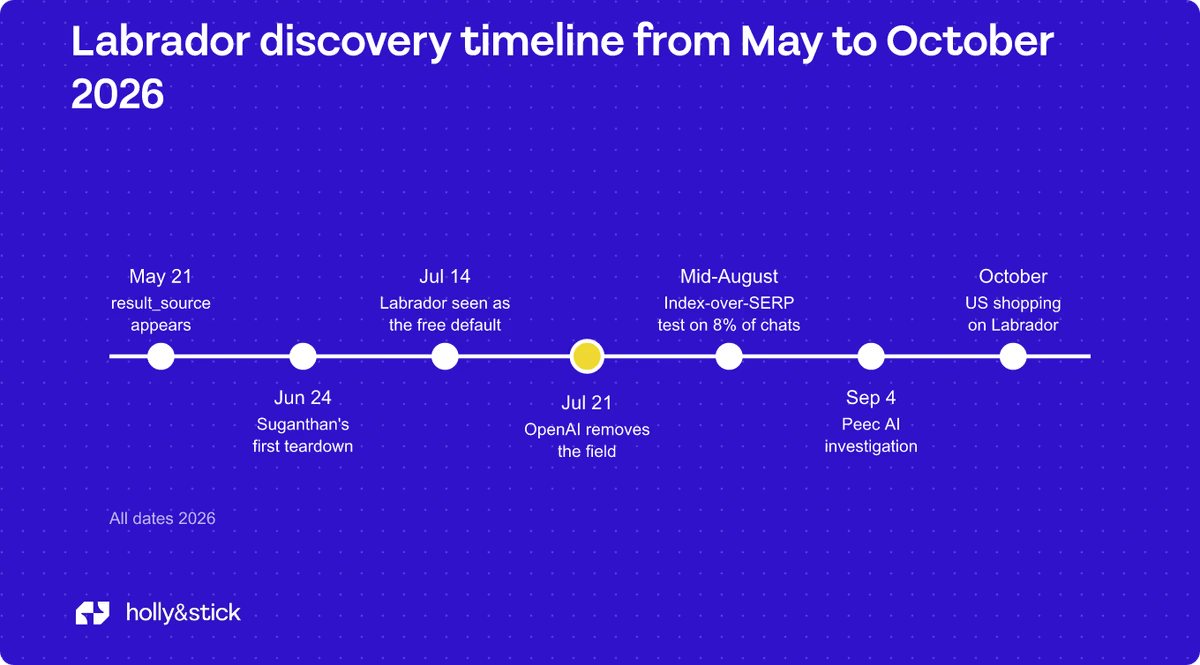
From May 21 to July 21, 2026, ChatGPT’s network traffic carried a field called result_source on every web result. You could read it in your browser’s DevTools, and it named one of four channels:
result_source | What researchers matched it to |
|---|---|
labrador | OpenAI’s own index |
bright | Very likely Bright Data, a commercial scraper that fetches Google results |
oxylabs | Oxylabs, another Google scraper, used for news |
serp | A third scraping channel, seen mostly on news |
Some accounts also reported a bing value in June and July. It never showed up for everyone.
Suganthan Mohanadasan published the first teardown of this field on June 24. Mark Williams-Cook had spotted three of the values, and Suganthan found the fourth. He first read labrador as an allowlist of established publishers like Reuters, the WSJ, and Wikipedia.
Then Simone De Palma, a reader on a free account in Italy, showed him that every citation he got was tagged labrador, small sites included. In a second post on July 14, Suganthan corrected his read. Labrador appears to be the default channel on free accounts, and the routing depends on the user’s cohort.
In July, Resoneo’s study already described labrador as OpenAI’s proprietary index. On September 4, Tomek Rudzki at Peec AI published the most complete investigation of it, with job postings and court testimony.
OpenAI removed result_source on July 21. Since then, nobody can read the channel labels on new conversations.
Labrador is a family of indexes
Peec AI found that Labrador is split by content type, like Google’s index:
- General web
- News, with separate tiers for the last day, the last 7 days, and everything older
- YouTube
- arXiv and Wikipedia
- Local
- Finance, legal, and medical
- Shopping
- Images
On September 17, David Konitzny published the full list of engines found in leaked retrieval metadata, a leak first uncovered by Metehan Yesilyurt. Most internal engines are Labrador variants, including news and Reddit ones. The external ones include Bing, Getty, SerpAPI, Yelp, and Foursquare.
Why OpenAI built its own index
In April 2025, Nick Turley, head of ChatGPT, testified in Google’s antitrust case. He said OpenAI had faced “significant quality issues” with one of its search providers, and Google turned down OpenAI’s request to use its search API.
According to Courthouse News, OpenAI hoped ChatGPT would use its own index for 80% of searches by the end of 2025. Turley said that goal was now “years down the line”. Peec AI reports that he also put at least five years on knowing whether 100% was achievable.
Peec AI also points to OpenAI job postings for indexing systems and retrieval pipelines, one of them for data systems at exabyte scale.
Not official
OpenAI has never confirmed the Labrador name or its architecture. It documents its crawler, OAI-SearchBot. And a help page on offline web search for enterprise workspaces says ChatGPT can answer from an index and a cache of web pages.
How does Labrador work?
ChatGPT works from two stores of your content, filled by different bots: a short snippet in the index, and a full copy in a reading cache.
OpenAI’s bots and what each one feeds
OpenAI’s crawler documentation lists four user agents. Three of them matter for ChatGPT search:
| Bot | Job | What it feeds, per Resoneo |
|---|---|---|
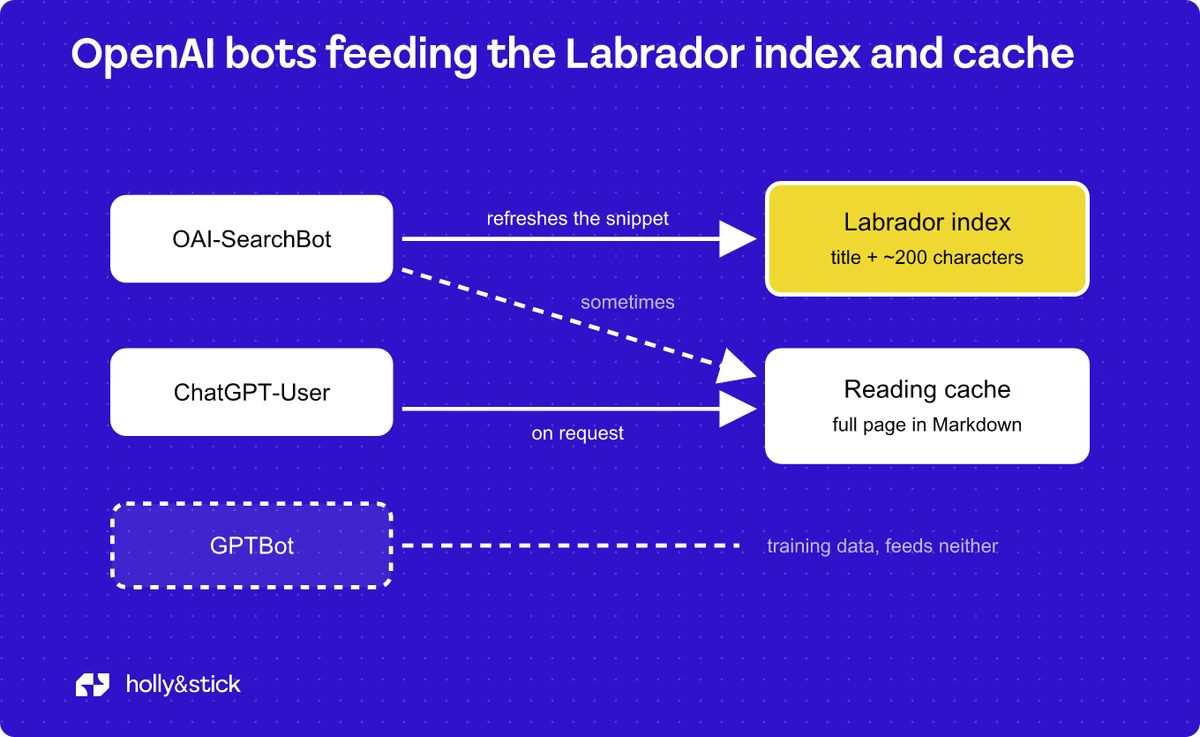
OAI-SearchBot | Crawls pages for ChatGPT search | Refreshes the index snippet, and sometimes the reading cache |
GPTBot | Collects training data for the models | Neither |
ChatGPT-User | Fetches a page when a user or the model asks for it | The reading cache only |
You can control OAI-SearchBot and GPTBot separately in robots.txt, so you can refuse training and stay in search. OpenAI notes that if you allow both, it may use one crawl for both purposes.
Resoneo measured this split with server logs, together with Jérôme Salomon from Oncrawl. The snippet in the index follows OAI-SearchBot’s visits within a few days. ChatGPT-User comes back more often, but its visits never change the snippet.
That doesn’t explain everything. In a Search Engine Land piece, Resoneo’s Olivier de Segonzac wrote that their test pages caught OAI-SearchBot “nearly silent while the index kept serving results”. Partner feeds also push news into the index without any crawl.
What Labrador stores about your page
For each result, ChatGPT receives a title, a URL, and a short snippet. Resoneo compared 534 cited pages with the snippet the index had stored for them:
- The snippet is cut at about 202 characters.
- It is taken from the start of the visible page text. The meta description is ignored.
- When the page has an H1, the snippet contains it 83.6% of the time.
- The title is kept in full, never truncated.
A typical H1 takes about 51 characters. That leaves roughly 146 characters of content, which is all the model sees of your page in most answers.
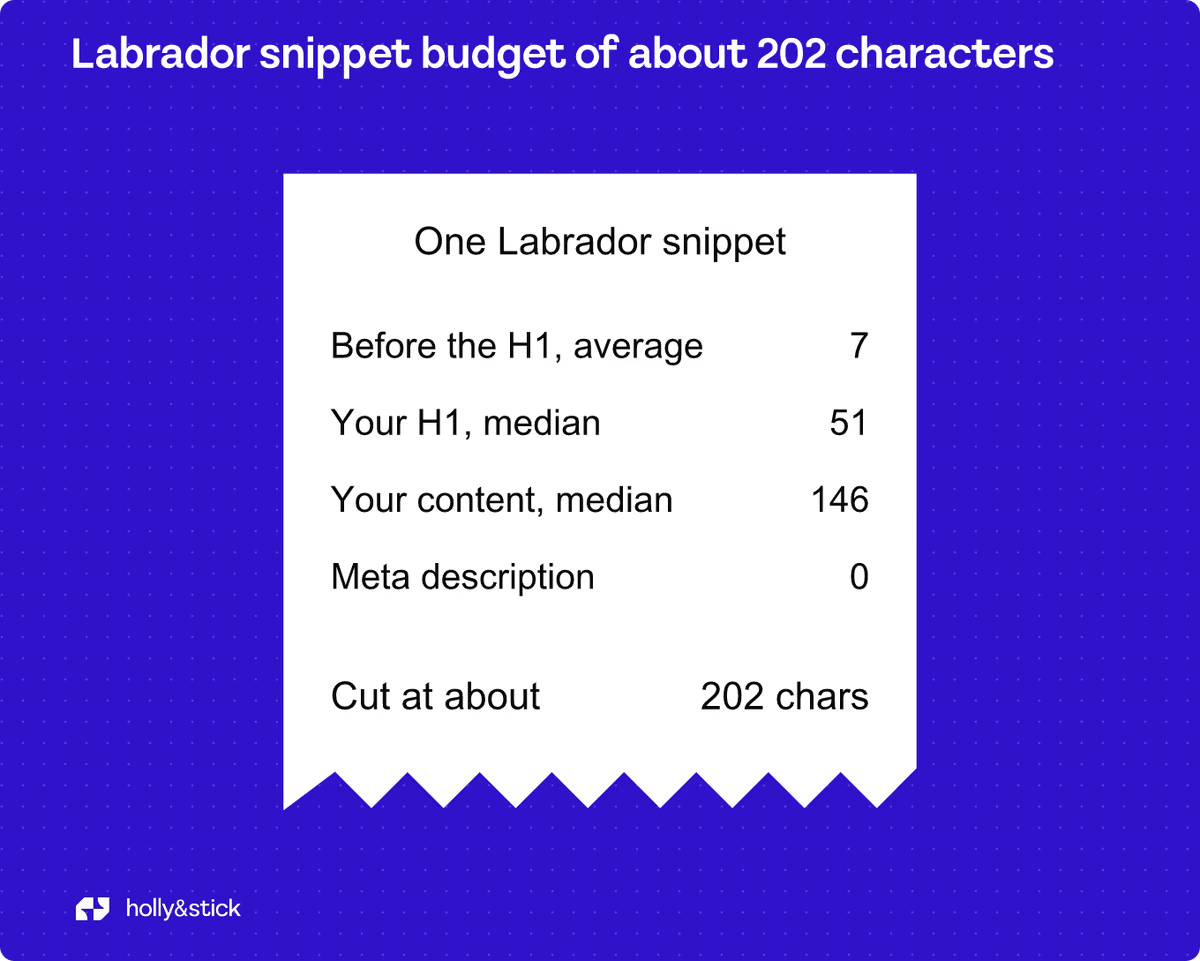
Some page elements eat into that budget before the H1. The two that matter most in Resoneo’s sample are a category label, found on 29% of pages, and the alt text of an image right under the title, which can cost 50 characters.
News results are the exception. They come with a summary of about 1,100 characters that OpenAI writes once and serves again.
ChatGPT rarely opens your page
Resoneo tracked 58,000 URLs retrieved by ChatGPT in July. About 7,600 were promoted to sources, 5,000 were cited in the answer, and only 760 were opened and read by the model.
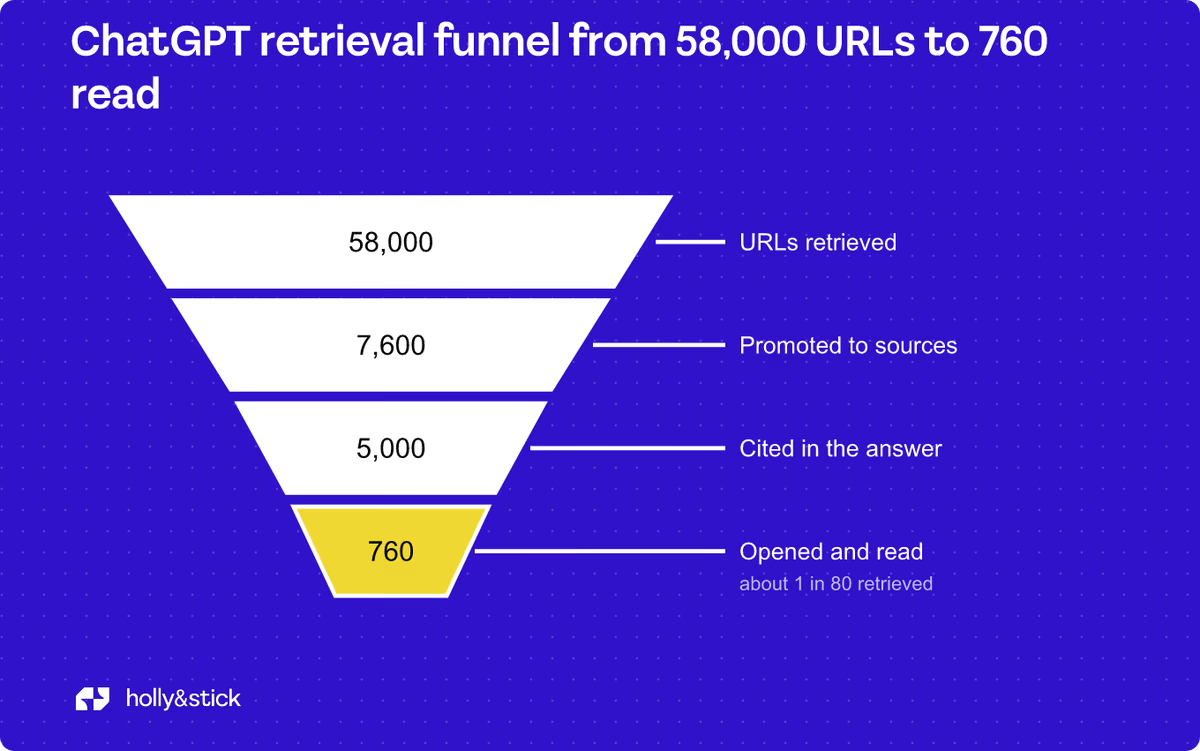
That’s one page opened for roughly 80 retrieved, nearly all of them in paid thinking mode. The rest of the time, ChatGPT decides from the snippet alone.
The index and the reading cache are two different stores
| The index | The reading cache | |
|---|---|---|
| Contains | A short snippet, frozen at crawl time | The full page, converted to Markdown |
| Used to | Find your page from a query | Read your page from its URL |
| Updated by | An OAI-SearchBot visit | A user request, once the cached page is older than about 30 minutes |
Both get old. In Resoneo’s data, 13% of snippets were more than a month behind the last crawl. Salomon found pages still served from the cache more than 90 days after they were fetched.
The cache also ignores the usual signals. Resoneo’s test pages sent a Cache-Control: no-store header and were cached anyway. Salomon found pages marked noindex in the cache too.
Does ChatGPT still use Google and Bing?
Yes. Labrador runs next to them, and the mix depends on the account and the mode.
Free and paid accounts don’t use the same engine
The Think button reached free accounts in August 2026. Resoneo asked the same questions on both tiers:
| ChatGPT mode (August 2026) | Labrador | Scraped Google | Oxylabs news channel |
|---|---|---|---|
| Free, Think | 74.7% | 3.1% | 22.2% |
| Paid, thinking (medium effort) | 24.7% | 75.3% | 0% |
Free instant mode was even more one-sided in July. Among results that came with a snippet, Labrador supplied 99.9% on stable information, 100% on businesses and places, and 97.6% on products. Only live questions, like a score or a rate decision, split almost evenly between Labrador and Google.
Most ChatGPT users are on the free tier. For most of your audience, Labrador is the main source of results.
If you audit your ChatGPT visibility from one paid account, you see one cohort. Check from a free account too, and from another country if your market needs it.
The other providers
Peec AI lists the providers it found next to OpenAI’s own crawler:
- Bright Data and Oxylabs, which scrape Google
- A third scraping channel for news
- Yelp and TripAdvisor for local results
- Two anonymous channels, one of which routes to Google Maps
- Microsoft’s Web IQ grounding platform
Bing shows up separately, mostly in Deep Research.
Malte Landwehr at Peec AI ran a simple test. He asked ChatGPT about a site with no organic traffic, and Google Search Console then showed a traffic spike for that exact site. ChatGPT still queries Google.
Shopping switched first
In mid-August 2026, Peec AI spotted a live experiment named prefer-index-over-serp-v3 running on about 8% of chats. By October, Peec AI found that US shopping ran on Labrador, fed by product feeds, while Europe still used Google Shopping.
For a B2B SaaS, shopping doesn’t matter much. It shows how OpenAI moves, one vertical and one market at a time.
What to change on your site
There is no “submit URL” button and no Labrador Search Console. Resoneo watched a fresh domain for 16 days without seeing a single page enter the index.
What you can control are the causes OpenAI’s own help page gives for missing or stale pages. It lists robots.txt blocks, bot-blocking CDNs, login walls, content that depends on scripts, new or low-signal pages, and deep pages that are hard to discover.
1. Let OAI-SearchBot in
Add an explicit rule to your robots.txt:
User-agent: OAI-SearchBot
Allow: /
OpenAI says a robots.txt change takes about 24 hours to apply. Sites that block OAI-SearchBot can still appear in ChatGPT as navigational links, but not as sources in answers.
Then check your firewall. Cloudflare and other CDNs often challenge unknown bots. Look for OAI-SearchBot in your server logs and make sure it gets a 200.
2. Write the first lines under your H1 as the answer
- One H1 per page. One page in seven in Resoneo’s sample had none, and the snippet then started at a random heading.
- A short H1. Every character the H1 saves goes to your content.
- The answer first. Say what the page is about and give one concrete fact in the first sentence.
- Nothing in between. Move category labels, dates, and images below the first paragraph, or check the alt text of any image that stays there.
Keep your meta description anyway. Resoneo found that the Google-fed channels still reuse it about one time in three.
The title is the other field ChatGPT always sees in full. Ahrefs found that cited pages have titles closer to the prompt and to ChatGPT’s fan-out queries than the pages it retrieved and discarded. Write titles that match the sub-questions your buyers ask.
3. Keep your facts in plain HTML
According to Resoneo, the fetch that reads your page doesn’t execute JavaScript, strips JSON-LD, and rejects pages over 4 MB with an HTTP 400 error. OpenAI’s help page also lists script-dependent content as a reason a page is missing.
This matters most on SaaS pricing and feature pages. Put plans, prices, limits, and integrations in server-rendered text, not in a widget that loads after the page.
4. Link every page you care about
Resoneo saw OpenAI’s training crawler, GPTBot, crawl all 8 test pages reachable by a link and none of the 8 listed only in the sitemap. It’s a small test on a different bot, and crawling isn’t indexing. Still, OpenAI itself lists hard-to-reach pages as a reason for missing content.
5. Earn the verdict on other sites
Suganthan’s first teardown showed a pattern that matters for SaaS, on a small sample he calls directional. Vendor pages got cited for their own facts, the pricing and the specs. The verdict on which tool is best got cited to third parties, such as review sites and comparison articles.
Your site can win “how much does X cost”, rarely “what is the best X”. For the second one, you need to appear on the pages ChatGPT trusts for verdicts.
6. Keep ranking on Google
Paid accounts still lean on scraped Google results, and the Google-fed channels serve live questions. A page missing from Google is missing for a whole part of ChatGPT’s users.
7. Treat freshness as a tie-breaker
Since mid-August 2026, each of ChatGPT’s search calls carries a number that researchers read as a freshness window in days. In Konitzny’s analysis of about 250,000 chats, 30 days was the most common value. About 65% of URLs retrieved for those requests fell inside it.
He also notes that the date ChatGPT reads is the first publication date, not the last update. And relevance still wins: in Ahrefs’ study, the median cited page from the search index was about 500 days old. Update pages when their facts change, not to chase a date.
How to check what Labrador holds about your site
There is no public tool and no site: operator. You can combine four signals:
- Server logs.
OAI-SearchBothits that return a 200 mean the crawler can reach you. Their absence doesn’t prove you are out of the index. - Your snippet. Take the visible text starting at your H1, skip the navigation, and read the first 200 characters. That’s roughly what ChatGPT gets.
- The API. Resoneo and Salomon queried OpenAI’s web search API with live web access turned off. What the model returns then comes from what OpenAI has stored, which is a cheap test for a developer on your team.
- Citation tracking. Run your buyers’ prompts from a free account and a paid one over several weeks, by hand or with a GEO prompt tracker.
Suganthan’s free FanoutFox extension also shows fan-out queries and sources in your own ChatGPT sessions. OpenAI has changed the format several times since July, so check that it reads the current one.
Should you optimize for Labrador?
Not as a separate project. The labels that exposed it disappeared on July 21, the search format keeps changing, and the entry rules are unknown.
Fix what every engine rewards. Let OpenAI’s crawler in, open each page with a clear answer, keep facts in HTML, link your pages, and earn mentions where buyers read verdicts. None of that is wasted if OpenAI rebuilds its search again next month.
FAQ about the Labrador index
Is Labrador an official OpenAI product?
No. It’s an internal label that researchers found in ChatGPT’s traffic. OpenAI only documents its crawlers and, for enterprise workspaces, an index and a cache of web pages.
Is Labrador the same as Bing?
No. Resoneo notes that about a quarter of Labrador titles are longer than 75 characters, where Bing always truncates. Bing is one of the outside providers ChatGPT uses next to Labrador.
What is the difference between Labrador and OAI-SearchBot?
OAI-SearchBot is the crawler. Labrador is the index where pages are stored and searched. A visit from the crawler doesn’t guarantee that your page gets stored, retrieved, or cited.
Can I submit a URL to Labrador?
No. Allow OAI-SearchBot, link the page from the rest of your site, and wait.
Does blocking GPTBot remove me from ChatGPT search?
No. GPTBot collects training data. Search depends on OAI-SearchBot.
Does noindex remove a page from ChatGPT?
Not reliably. If content must stay private, put it behind a login.
Can I still see result_source in DevTools?
No. Fan-out queries, sources, and citations are still readable in your own sessions, but the field that named the channel is gone.